

Story
We last saw Odysseus sailing away from Ogygia. He’d left Calypso, the island, and immortality behind in a raft she helped him build.
Athena had taught him to steer by the stars and for 17 days he sailed alone. On the eighteenth day, he saw the dark outline of the mountains of Phaeacia - a magical island kingdom - on the horizon. He wasn’t home yet, but he was well on his way.
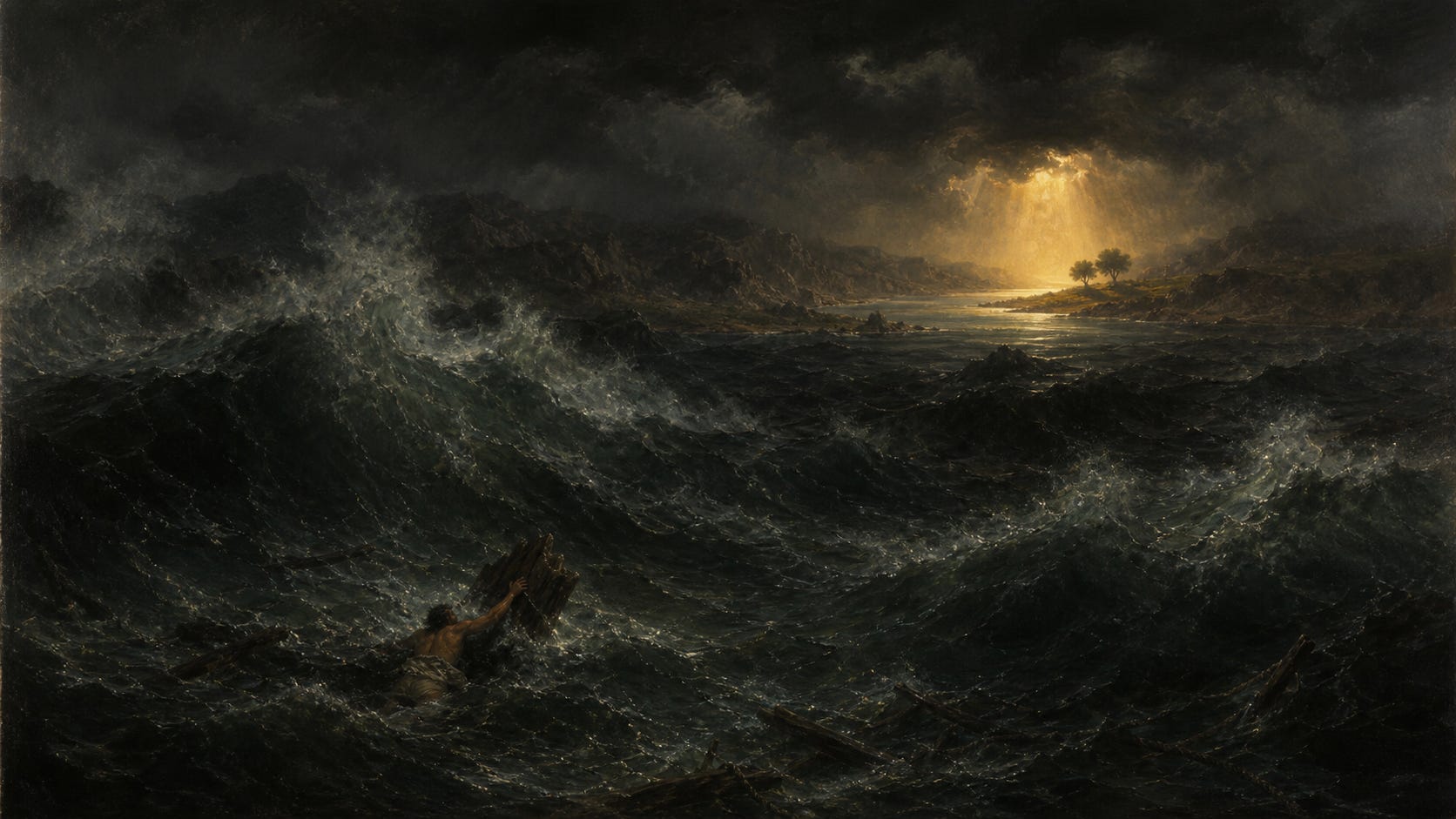
Unfortunately, Poisedon saw him too. He still hated Odysseus for blinding his son, the Cyclops Polyphemus, years before. Seeing his enemy this close to land, this close to freedom, Poseidon raised his trident and called every wind at once. Black clouds swallowed the sky. Waves rose like walls. The mast snapped. The raft that had carried Odysseus for seventeen days came apart in an instant.
His death was certain now. He’d escaped Poisedon 9 times before, but this time there was no way out. He should have just died at Troy with honor instead of dying alone in the middle of the sea. He clung to a single plank and waited to go under. Breathing more water than air with every breath.
That was right when a sea goddess named Ino saw him. She had once been mortal herself, and was caught in an abusive marriage with an insane king named Athamas. She had thrown herself off a cliff into the ocean to escape him in death. The gods showed her pity by transforming her into a goddess. When she saw Odysseus, she rose out of the water in the form of a seagull and landed on the wreckage beside him.
She gave him a veil and told him to wear it and remove the clothes Calypso had given him. After changing his clothes, Ino told Odysseus to let the plank go. Her veil would protect him from drowning. He could take her veil with one condition, that he throw it back into the sea when he found himself on land.
The only issue was that Odysseus was still alive because of this plank. The raft might have been gone, but he was still floating. Letting go of it felt like giving up his only chance to survive. He was also well acquainted with the gods’ trickery, and was not sure that Ino was actually there to help him.
He did it anyway. He tied Ino’s veil across his chest, and started swimming with nothing else to hold onto.
The sea threw him wherever it wanted. Yet the veil protected him from drowning. After two days and nights of struggle he finally saw the shore. However, this wasn’t a gentle beach. It was a wall of jagged rock. The waves now hurled him towards the rocks. As he hit up against the rocks, he reached out and grabbed them. Then the undertow tore him backward. Ripping the skin from his hands. He found a way to swim parallel to short until he found a river mouth where he could crawl onto land. More dead than alive, he collapsed beneath two olive trees that grew together into one.
He dug himself into a pile of dry leaves to keep warm. He had made it through the storm, but now he was on a strange island with no raft, no clothes, no men and no plan.
Truth
Odysseus did the right thing. And he was nearly killed for it.
We often make assumptions about “right” decisions. We think that the proof that we made the right decision is that our lives get easier, happier or at least we feel some relief. Many times, it seems to be the opposite.
Right decisions cost a lot more than wrong ones.
For some people, making the decision is hard enough. But what they don’t realize is that the decision isn’t the hard part. It’s what comes after the decision.
What saved Odysseus?
It wasn’t him charting a course and sailing for 17 days on a raft he built himself. Sure, that got him close, but then all that progress was destroyed in an afternoon.
What saved him was letting go of his plan to get home.
He had to have a realization that if he was ever going to get home, it wouldn’t be under his own power. He couldn’t do it on his own and would have to have help. And this help would come from sources he’d never had to trust before.
Think about that in relation to the decisions you’re making right now. You’re making the decisions, but the outcomes aren’t up to you. You’re having to trust.
That’s a hard bargain. We are taught to build rafts our whole lives. Common wisdom says that our knowledge, competence and planning is what will keep us afloat. So when the storms come, we develop the instinct to hold on tighter to what we’ve been told is supposed to be our way to the dream, vision, or goal.
Ino told Odysseus to let go.
God tells us the same thing.
“Trust in the LORD with all your heart, and lean not on your own understanding; in all your ways acknowledge Him, and He will make your paths straight.” (Proverbs 3:5-6)
Sometimes…well, maybe most of the time, making the right decision means letting go of what you understand; what’s rational, comfortable and safe.
In the gospels of Matthew, Mark and Luke there’s a similar story to Odysseus. Jesus is in a boat with his disciples, and he falls asleep. A storm showed up that was dangerous enough that these lifelong sailors were scared for their lives. Jesus was still asleep. They wake him up, he gets up, stops the storm and asks them where their faith was. Why would Jesus ask this question? They had forgotten who was in their boat.
We will try to build our lives on our plans, competencies and what we understand. None of these things are wrong. However, in all our personal growth, empowerment and development, we can often miss something. Our plan for our life ≠ God’s plan for our life.
God’s plan is better than our plan, but it’s also not within the realm of our understanding. Therefore, we must learn to place our trust in something outside of us that we cannot control.
We will all do the right thing and find ourselves in the water, clinging to a plank of our understanding at times.
The right thing to do is let go.
Practice
What are you holding on to that’s keeping you afloat in the midst of what you don’t understand?
Is this helping you, or are you just afraid to let go of it?
God wants to use everything in your life to bring about his plan. Which is good, pleasing, perfect and better than yours. You’re not going to understand it right now. So instead of thinking about what makes sense, start to think about where you can place your trust in God.
What does it practically look like for you to trust Him right now?