

“Opinions are like armpits, everybody has them and most of the time they stink.”
The quote I have always heard is a little different than this one, but this is a PG rated letter, so we’ll keep it that way.
It seems like when we make decisions about anything, there’s always someone around us who wants to share their opinion with us about their decision that we’ve made. This happens so often that we often make decisions and then spend the next three days, monitoring, observing, and digesting how everyone around us - even strangers on the internet - are responding to it.
Story
Aesop tells us a fable about a miller, his son and a donkey. A miller was one of the most common trades in the ancient world. They would take the crops from a city and crush them into flour with heavy millstones. They were highly skilled laborers and were integral to their local economy.
This particular miller live with his son just outside of his town. One morning they set off to sell a donkey.
They hadn’t gone far when a group of women at a well called out: “Look at those fools. They have a perfectly good donkey and they’re walking.”
The miller thought it over. Then he lifted his son onto the donkey.
A little further on, old men in the shade shook their heads. “Shameful. That lazy boy rides while his father walks.” So the miller switched. He rode, his son walked.
They hadn’t gone much further before a woman passing the other direction scowled, “How can you ride in comfort while your poor child stumbles in the dust?” The miller decided that he and his son would both ride the donkey.
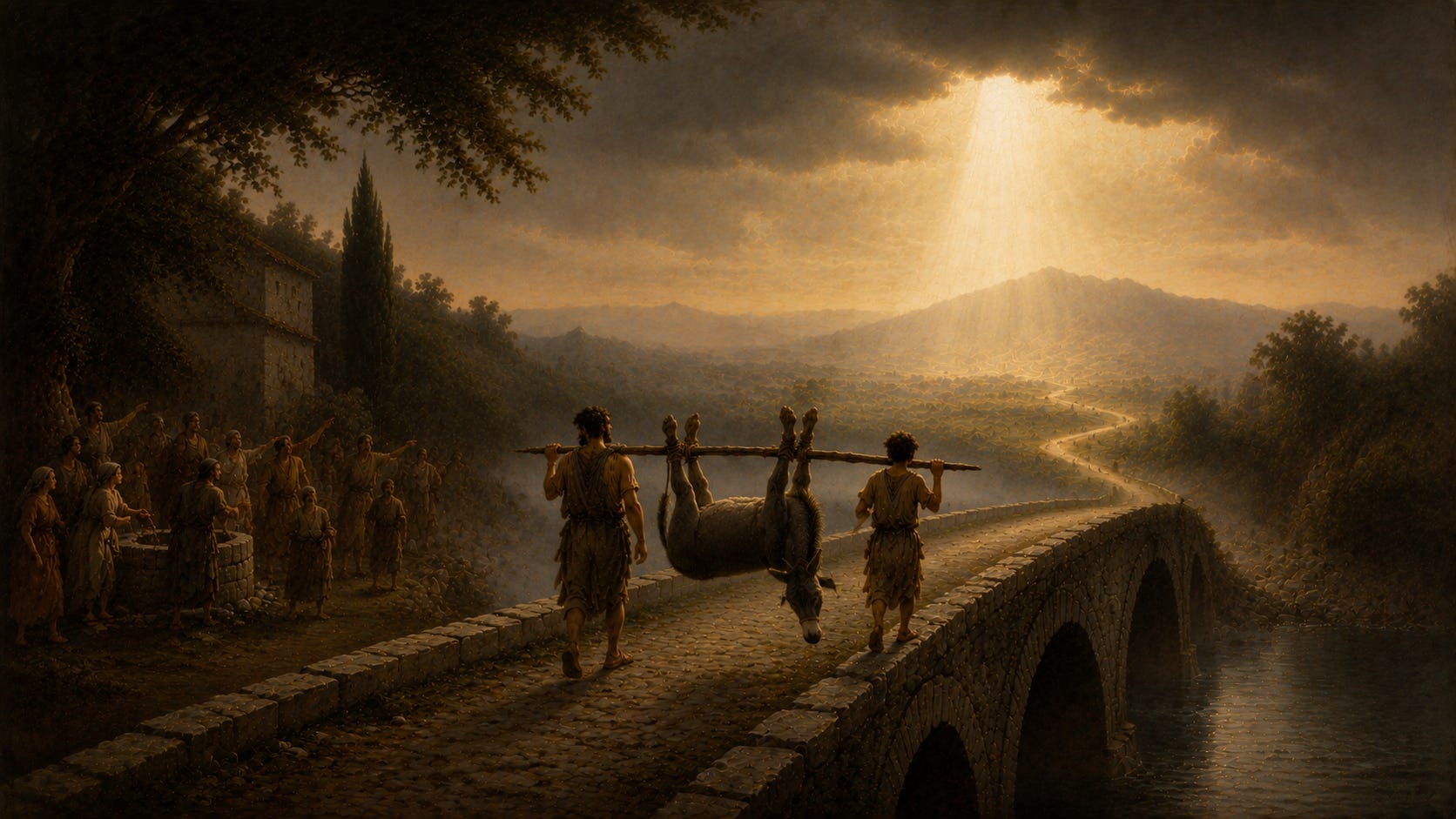
Once they entered the town, people began to stare and whisper, “how cruel. Two riders on that poor beast.” The miller, desperate to finally do right by everyone, did the only thing left to do. They would carry the donkey. They bound its legs to a pole and hoisted it on their shoulders.
On the bridge into the market, the donkey panicked, broke free from the pole, and fell into the river.
It drowned.
They had come to sell the donkey. They went home with nothing.
Truth
Every critic along the road wasn’t entirely wrong. It wasn’t bad advice that killed the donkey. It wasn’t too much advice either. It was the application of all the advice to please outsiders.
In my twenties, I worked for our church as a Creative Director. One of the dynamics of working in this kind of position in a larger organization is that everyone is mad at you at one time or another. There’s a Lead Pastor who serves as the CEO of the church, but then also, there are all kinds of different leaders and ministry directors who think that they have taste. From a leadership perspective, of course the CEO makes the ultimate decisions, but each leader also sees themselves as the CEO of whatever area they are over. Add to this your own personal creative taste and making creative progress in this type of environment can be difficult if you care about pleasing people.
I wouldn’t call myself a people pleaser. However, all of us should care about what people think on a level, most of our jobs depend on it. As much as I don’t care about pleasing people, I do care about providing for myself. And a significant aspect of providing for ourselves requires that certain people are happy with us. This felt like a dilemma that I didn’t know how to fix. I ended up having a conversation with my mom about it and she said something very simple that changed my life: “You just have to choose who you are willing to disappoint.”
That thought changed my life.
In the story of the miller, the problem was not that his plan was bad. It was that he allowed his plan to be altered so much by the desire to make people who weren’t a part of the plan happy. He actually ended up sacrificing his plan for the sake of making random people happy. These people were not invested in his success, didn’t care about his plan, and were just spouting their opinions. Like most of the people around us.
Proverbs 15:22 tells us that there is “wisdom in a multitude of counselors.” When we get other people’s perspective on a problem or plan, we are given the gift of a vantage point that we didn’t have before. That’s a great gift, however, it’s one thing to get someone’s perspective, its another thing to change your plan based on the perspective.
There’s a difference between getting people’s perspective and applying it. You can get a lot of people’s perspective, but you can’t apply all of it. Their perspectives will often oppose each other and pull you in opposite directions.
Maybe we can, and should get as many perspectives as possible. However, it seems that we should also be intentional about whether or not we apply those things to our life.
Practice
How do we know who to listen to? Ask yourself these types of questions:
Does this person have good fruit in the area of their life they are giving me their opinion in?
Is this person valuable to me?
Does this perspective help me to get to where I need to go?
What happens if I disappoint this person?
Did I believe this decision was right before they said anything? Why?
Does this person want what’s best for me?
Am I afraid of being wrong? Or of being judged?
Most importantly, decide who you are unwilling to disappoint.
That list is usually a lot shorter than the people who are giving you their perspective. I only have three people on my list:
God - Ultimately, I am not trying to “win the approval of human beings…” (Galatians 1:10) I want to live by conviction.
My parents - I both work with them/for them and they are my chief mentors, I respect their voice the most in my life.
My wife - I will do everything I can to make sure the life we live and what I do honors her and keeps her happy.
Finally, before you change a decision because of someone’s reaction, stop and ask:
Am I changing this because they’re right — or because I’m uncomfortable with their disapproval?
Most people live their lives by committee instead of conviction. They don’t do the right thing, they do the thing that the greatest amount of people approve of. That’s the road to a failed life. Don’t kill your donkey trying to please people who don’t care.