

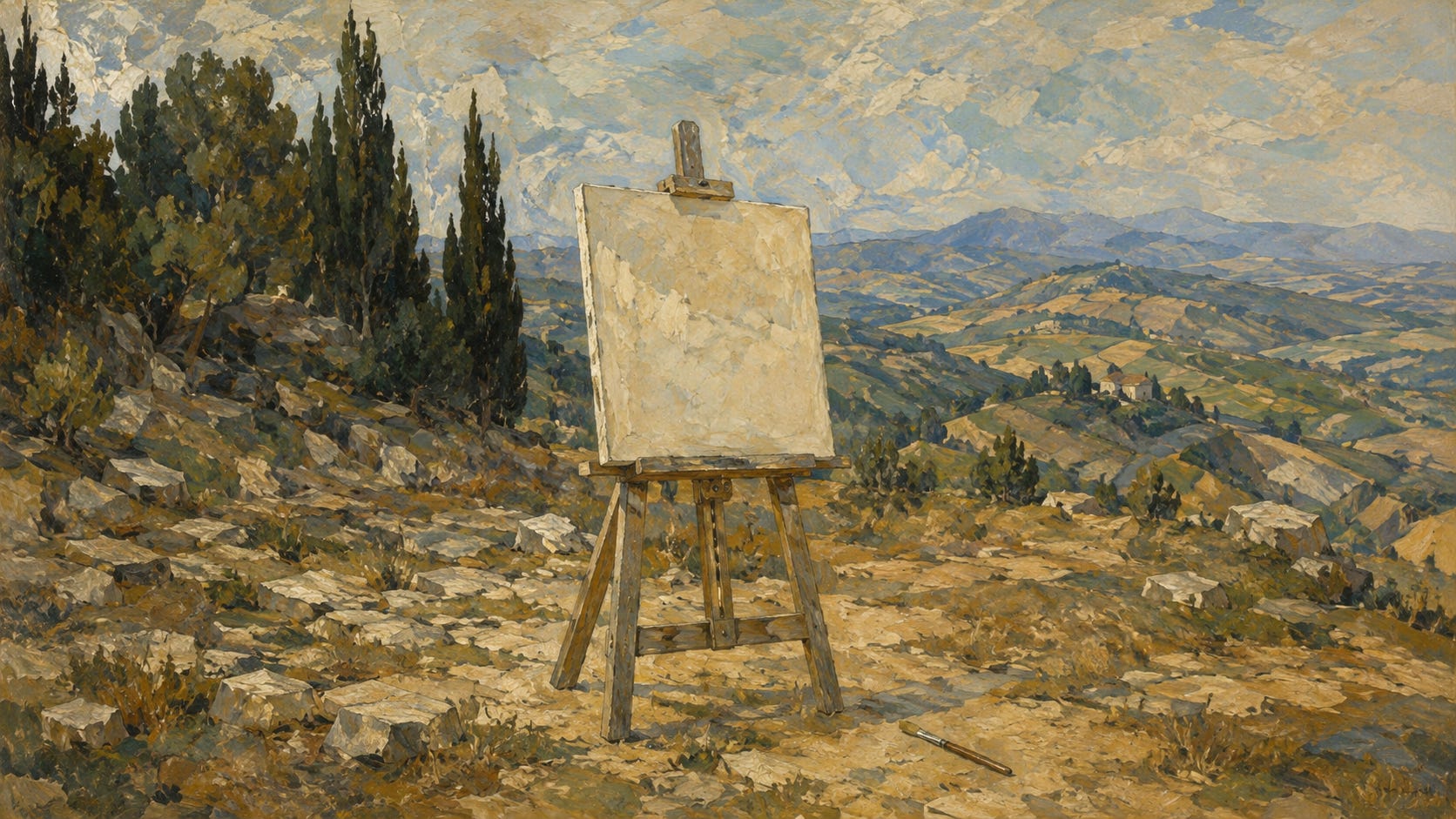
“Living life as an artist is a practice. … The real work of the artist is a way of being in the world.” / Rick Rubin (The Creative Act)
“You are both a work of art and an artist at work.” / Erwin Raphael McManus
“For we are God’s workmanship, created in Christ Jesus to do good works, which God prepared in advance as our way of life.” / Ephesians 2:10
In Ephesians 2:10, the Greek word Paul uses for workmanship is ποίημα (poíēma). This word means: a unique creation unlike anything else, a work of art and divine inspiration.
The oldest art form is the story. We told stories long before we developed the technology to write or mix pigment to paint a cave wall. Before writing, stories were how we passed beliefs, ideas and knowledge from generation to generation. Every known civilization and culture throughout history has storytelling traditions. The fundamental context of human existence is the story. The way we connect with those closest to us is through the stories we tell them and the ones they tell us. We think in stories. They are how we understand the world.
We have created literature, theater, radio, film, television and innumerable other mediums to tell stories. The ultimate storytelling medium is our own life. Our life is not a series of random data points. There is a flow and a sequence. Our lives are stories. We are simultaneously telling and writing our story. Great stories are great masterpieces. We are both artist and work of art. Great masterpieces require the work of a master. There is an art to living. To tell a great story with our lives, we must learn to master this art.
Philosophy
I’ll never forget The Matrix and Gladiator. I was 12 when The Matrix came out in theaters and 13 by the time I saw Gladiator. The Matrix is not just one of the greatest sci-fi movies of all time, it also incorporated philosophy, theology and history in a way I had never encountered before. This story gave me the idea that maybe things in the world are more connected than they seem to be on the surface. Then I saw Gladiator and I learned that Marcus Aurelius was a real person and interacted with Meditations for the first time. Watching a spiritual/philosophical movie, then learning about a real philosopher and his philosophy affected me deeply. I was raised by what I would call a Biblical philosopher – my dad. He would have never called himself that. But his approach to life informed my approach to life and still does. One of the ways he shaped my thinking was with Augustine’s idea that “(a) person who is a good and true Christian should realize that truth belongs to his Lord, wherever it is found, gathering and acknowledging it even in pagan literature . . .” (On Christian Doctrine)
I was raised in a Christian home, but with a key difference from many people I knew. For most people I knew, questioning was off limits. Accepted truth, tradition and belief never needed to be challenged. In my family, questioning was embraced. Not for the sake of asking questions, but for the sake of clarity. From a young age, my parents both encouraged the seeking of truth. Which, throughout my life has led me many places. True stories, myths, legends, philosophy, theology and history. These influences have come together to form my story and how I tell it.
I firmly believe all truth is for the purpose of feeling our way towards God and finding Him. I am not a syncretist. I do not believe that all things in all philosophies are true. But all philosophies contain elements of truth. And these elements point to a greater truth. What my story has revealed to me is that truth and its universal laws existed long before any man-made philosophy or religion.
I am not a master of theology, philosophy or any other subject, but a fellow seeker. Our journeys are all unique and singular. What I find interesting is that the questions we are often asking are not. People have asked these same questions in their stories for thousands of years. The goal of understanding the philosophies of the past is not simply for information. It is for understanding its implications for our future. We are not the first people to ask the questions we are asking. The way that the people of the past answered those questions has determined the present. The way we answer these questions now will determine the future.
You must understand that you are a philosopher. I am too. We all are. We make decisions every day, and our philosophy is simply our criteria for making decisions. The question is not whether we will be a philosopher, its whether we will be a good one.
Context
“The mystery of life is not a problem to be solved; it is a reality to be experienced” // Søren Kierkegaard (Source)
Our life is a story we are writing with every decision we make. This story began the day we were born. Every day we live, we write more lines and chapters.
Not every story becomes a masterpiece. Not every person lives a good life. What’s the key difference between a good life and a bad one? What’s the key difference between a good and bad story? Context.
In storytelling, the way a story is told matters just as much as the content of the story. Context is the structure of the story. Context gives a story meaning and importance. It’s what helps us understand the story. Without the right context, stakes are unclear, events feel random and it’s unclear why things matter. This is what happens when we see life as a singular problem to solve. Seeing life as a problem often means that we separate ourselves from our context. There are problems in life, just like there are points of conflict within a story. However, in a story, problems are interconnected. To see our lives as a reality we experience means that we understand that problems are not random events. They are the context of our unique story.
The wrong questions in the wrong order
The first problem we have in telling our story is the kind of questions we are asking. There is a difference between treating symptoms and causes. A broken leg can cause intense pain. If we give a person with a broken leg painkillers, they will feel better temporarily. But painkillers won’t heal the break, no matter how strong they are. They will only treat the symptom (pain) of the cause (a broken leg). By numbing the pain, we solve one problem, but not the main problem. And if we numb the pain for long enough, we may make it worse because we will “feel better” and think we are fine. One of the reasons why we prefer to treat symptoms is because of how straightforward those solutions are. It’s easier (and less painful) to take a pill than it is to set a broken bone or wear a cast during the healing process. But that will only bring temporary relief.
We often assume that our problem is a lack of money, fame, position, influence, success, etc. I’ve heard many people sum these up as the “three P’s”; power, pleasure and possessions. We believe that if we can gain some, or all of these things, we will have solved our greatest problem. However, we don’t want these things for themselves. We want them because of what we think they will mean to us once we acquire them. We think they will make us happy. We think that acquiring them is the substance of a good life. We think they will make our lives meaningful. We are misdiagnosing our problem. Which leads us to ask the wrong questions.
What we call our problem is often only the visible form of a deeper hunger. Our real problem is that we lack meaning. We are unhappy and unfulfilled. We think the cause of our lack of meaning is a lack of the three P’s.
We have a broken bone and think that taking more painkillers will fix the broken bone. The process for healing the broken bone is completely different than the process for managing the pain. Power, pleasure and posessions can improve our lives. But they won’t solve our problem. In fact, they can make the problem worse. Often, when a bone heals in the wrong position it can cause further pain, deformity, and a loss of function. Many times, surgeons must correct these problems by cutting (rebreaking the bone in a controlled way), realigning it and fixing it with hardware like screws and pins. The same can be true in our lives. A person can learn to live trying to numb their pain, avoiding what hurts and managing their dysfunction. This will only lead to more problems. There is a process to healing a broken bone. By avoiding that process we delay healing as well as make our lives harder. The same is true in our own story. Without treating the cause of our pain, it will never be healed. We must learn to understand that we are primarily seeking meaning. This is our question.
Understanding that life is a reality to experience means that we see our life as a story. It’s not that life doesn’t have problems. Seeing life as a reality is having an understanding that problems are not random. They not isolated, they belong to a structure. They are interconnected. If we do not understand the order of life, we will misunderstand the problems within it. That doesn’t mean that life is always logical. Sequence is the order that things happen in, logic is the reason they connect to each other. In storytelling, the sequence of a story is its timeline. Every story has a beginning, middle and end. This is sequence. Our brains are wired to perceive everything this way. Learning this about ourselves, we can learn to ask the right questions in the right order.
The right questions in the right order
There’s a story we tell ourselves about our life. That story begins in our past. These events are a reality. There are events, and there are what the events mean. The past happened, but it also did not explain itself. What matters more than what happened in the past is the meaning we have given to it.
Our present is a combination of the story we tell ourselves about the past, and what we believe that means for our future. The past doesn’t exist anymore, and the future doesn’t exist yet. What the past “means” is something we decide for ourselves. It is important that we understand meaning because the future is created by the decisions we make today. The decisions we make today are directly influenced by the story we tell ourselves about the past. Or, what we have decided that the past means to us. Our lives are a story – reality – that is layered.
Layer 1 - The world outside of us
When a person is a child, they spend most of their time trying to understand the world around them. They rarely think about themselves, or their decisions. When we ask children why they do what they do, they say “I don’t know” more than any other answer. If you ask a child to explain who they are, they probably won’t understand the question outside of being able to say their name. Of course this is dependent on their age. The older a person gets, the more they develop identifiers and become aware of what makes “them” them. What a child spends most of their time trying to do, is make sense of the world that they are living in. As of writing this, I have three daughters, an eight-year-old, a six-year-old and a two-year-old. The number one question I get from them is: “Why?” Why is the sky blue? Why does the wind blow? Why do leaves fall off trees? Why does thunder make noise? Why do you have grey hair? Why is the moon following us around? Why does ice melt? Why is it so hot outside? (we live in Texas) Why does that person look like that?
The second most-asked question is “What?” What makes rain? What is dirt made of? What is blood for? What is a boy/girl? What is that smell? What does this button do? When we ask these kind of questions, we are primarily talking about:
The past
Things we can’t control
The first part of our journey is trying to understand this first layer of reality. Some of the most important distinctions we can make are made here. This is when we begin to understand that there are some things we can’t control, and some we can. As well as what is real and true and what is not real and false.
Layer 2 - The world inside us
As we grow older, we begin to consider the next part of our journey. We start to think about the world inside of us. Psychology calls this self-consciousness. This also comes in the form of why and what questions. What am I good at? Why do I feel this way? Why am I different from those people? What do I like/dislike? What’s wrong with me? Why do I have to do hard things? Why do I care what they think? We also add a new question. “Who?” Who am I? Who am I supposed to be? Who do I want to be? These kinds of question describe:
The present
Things we have some control over
As we grow, we learn to navigate these two layers of reality. None of these realities are cleanly separated. They ask different questions. Sometimes these questions come simultaneously, but we get to decide what order we answer them in. We all have experiences. Some we control, some we can’t control. We have a response to those experiences. The way we see ourselves is often defined by how we see our experiences. Simultaneously, the way we see our experiences is defined by how we see ourselves.
Let me give you an example. In my experience, all cats are evil and I hate them. I know hate is a strong word to use. The dictionary definition of hate is “intense or passionate dislike.” I hate cats. Growing up, I had a babysitter who had cats. I’m sure there are good cats and bad cats in the world. These cats were supremely evil. They would go out of their way to bite me, scratch me, and generally disturb me. All of this was before I found out I was allergic to them. I would wonder why anyone would keep a cat if they sneak attack you, make your nose run, eyes itch, and sneeze almost uncontrollably. Based on my experiences – what happens to me – with cats, I have concluded something about myself – what happens inside of me. I am not a cat person and never will be. I am not sure I will ever associate with people who are cat people. This process is subconscious for us. Experiences provoke responses. These responses can transform into our identity. This identity then dictates our choices.
Layer 3 - The world we create
There is a third layer. The reality we create – the decisions we make every day. What should I do? Who am I trying to impress? What do I want out of life? Who do I want to become? What happens if I fail? What is expected of me? What do I owe myself? What do I owe to others? Why am I alive? What is my purpose? Who do I trust? Who do I love? Why do I trust/love them? These questions are about how the decisions we make every day affect who we are and the world around us. When we consider these questions, we are thinking about:
The future
What we can control
Three realities, three steps
Instead of trying to answer all the questions at once, what if we tried to answer them in sequence? This is not just where a child starts, it’s where ancient philosophers started. They attempted to make sense of the world before trying to make sense of themselves. After making sense of themselves, they realized the power they had to live a good, meaningful life. There seems to be three simple questions that lead us to living a meaningful life.
What is truth? – The reality outside of us
What truth is, why it matters, and how we can distinguish it from falsehood.
Who am I? – The reality inside of us
Our desires, identity, inner conflict and the discipline required to live a good life.
What is the meaning of life? – The reality we create
A good life is built through virtue, responsibility, purpose and following Jesus.
These questions are simple to ask, but hard to answer. They are what have led me on a search through theology, philosophy, history and myth. I don’t believe this search ends with more questions. It ends with a logical answer. There is a Way to live a good life. This is not an idea to simply understand. The Way is a person to be followed. The human journey through truth, identity and meaning finds its fulfillment in Jesus. Not as one option among many, but as the culmination of what philosophy sought, what myth hints at, and what we have always longed for.