

Story
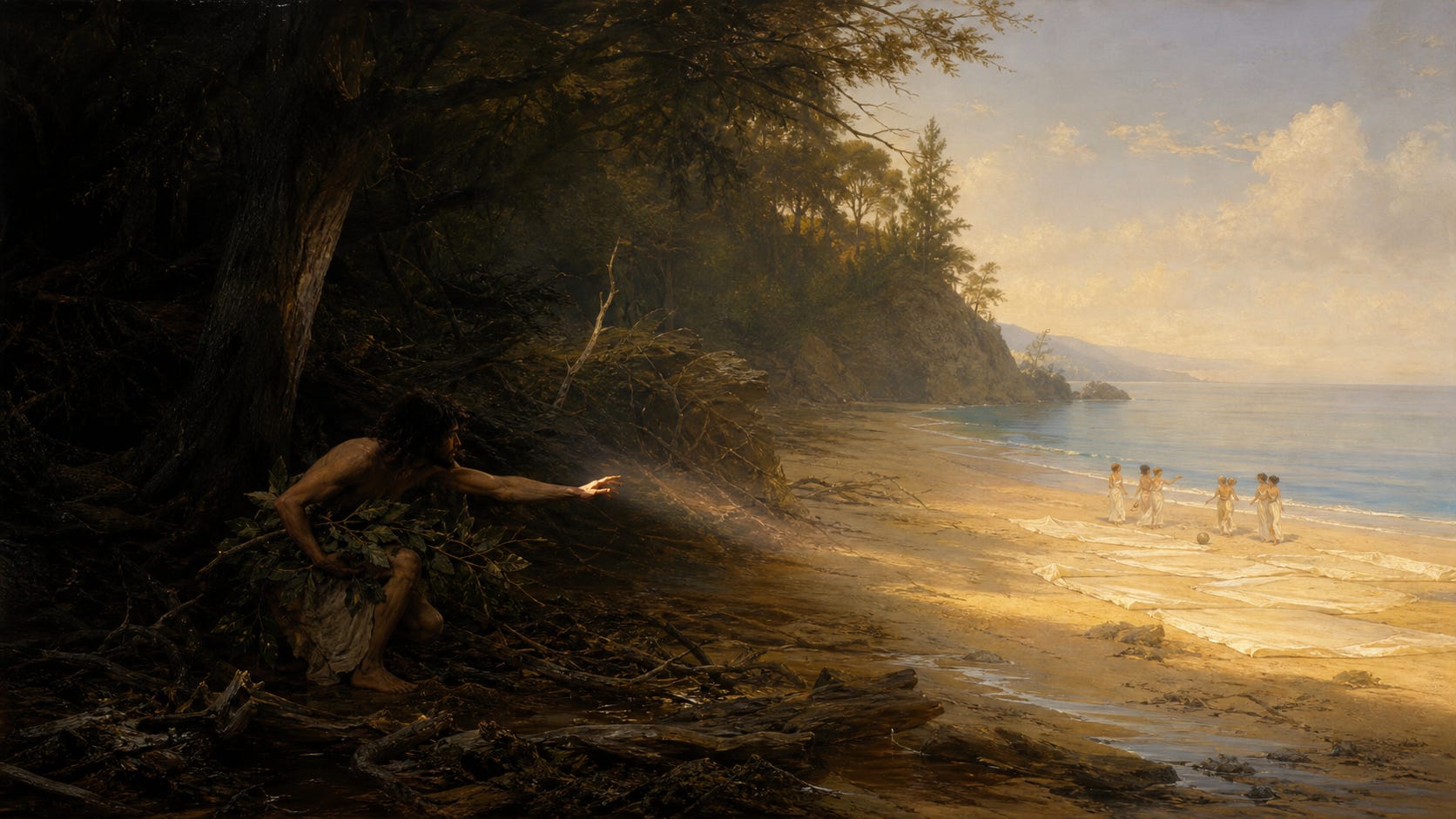
Surviving Poseidon’s wrath with Ino’s help, Odysseus makes it to shore and collapses beneath two olive trees. He’s naked, half dead and buries himself in a pile of leaves for warmth and falls asleep out of exhaustion.
He awakes to the sound of girls laughing.
Nausicaa, the princess of the island was visited by Athena in a dream and guided to wash her clothes in the river that morning with her maids. After washing their clothes, they began to throw a ball to each other on the beach while their linens dried. One wild throw landed in the river and the girls screamed, waking Odysseus.
He crawled out from the underbrush, filthy, salt-crusted, naked and holding a leafy branch in front of himself for modesty. Every maiden except for Nausicaa ran away. Odysseus asked her kindly for directions to the city and if she had anything to spare so he could cover himself.
She asked her maids to bring him olive oil to wash the salt off his skin and clean clothes from her brother’s chests. She asked him to follow her wagon into town, and gave him instructions on what to do as soon as he reached the palace: walk past everyone in the courtyard and go directly to her mother - Queen Arete. The only problem was that town was full of people and the Phaecians were hostile to strangers and outsiders. How would Odysseus make it that far? Athena shows up disguised as a young girl carrying a water pitcher. She begins to pour a thick mist all around him, wrapping him in it so he becomes invisible to everyone he passes. She then guides him through the streets to the palace and tells him about the layout of the palace and tells him how to approach Queen Arete.
Odysseus takes this journey and finds himself in an extravagant hall with walls made of bronze and a silver threshold. At the end of the threshold were bronze watchdogs that Hephaestus - the god of fire - had forged. He sees the queen and falls at her knees to tell her his story. As soon as he hits his knees, his cloud of invisibility disappears.
Odysseus did more than tell her his story, he took a ritual posture in ancient Greece called ἱκεσία (hikesia). The English translation for this word is supplication.
This wasn’t begging, this was an ancient unwritten law. The Greeks believed it was a tradition handed down by the gods. A sacred plea for protection and refuge from a person who had no ability to care for or protect themselves.
Odysseus had nothing. He had no men, no ship, and no plan. He didn’t even have any clothes. He was stuck on this island and his only chance was the mercy of the king and queen. However, this wasn’t improvised desperation, this was the official way to ask for mercy and protection. Odysseus implored Queen Arete for help to get home.
At this moment, her husband, King Alcinous heard him speak, lifted him up, set him by the fire and promised him a ship home.
There was a banquet that night and Odysseus was invited. A blind singer played the lyre and sang of of the wooden horse, the fall of Troy and ten years of war. Odysseus heard his own life story told to him and it made him weep.
King Alcinous was the only one who noticed. He stopped the music and asked”
Who are you?
Truth
Odysseus didn’t improvise his request out of desperation. He knew the ancient way to ask for help and he followed it.
ἱκεσία wasn’t an emotional breakdown. It wasn’t getting emotional and distraught and throwing yourself at a person’s feet. Everyone knew the process. Kneel, touch the person’s knees, and state your need. If a person was asked for help in this way, it obligated them to respond positively to the request. It wasn’t about returning favors or reciprocation. Even though Odysseus had nothing, he still had the ability to practice ἱκεσία. Asking for help wasn’t his last resort, it was a part of the normal process.
In the Western world, we can’t fathom this. We’ve turned asking for help into something we do at the bottom. Something we only stoop to when we are desperate. We white-knuckle as long as we can, and only once we’re completely broken do we ask for help. Our request for help isn’t composed at that point, it’s chaotic.
That’s not the way God prefers for us to ask for help. Hebrews 4:16 says it this way /
Let us then approach the throne of grace with confidence, so that we may receive mercy and find grace to help us in our time of need.
When the writer of Hebrews says the word confidence, they use the Greek word παρρησία (parrēsía). This word means “freedom in speaking all one thinks or pleases.”
To approach with confidence doesn’t mean to crawl once we’ve exhausted every other option. It means to live our lives in a way that asking for help is a normal part of our experience.
Practice
Paul says in Philippians 4:6
“…do not be anxious about anything, but in everything by prayer and supplication with thanksgiving let your requests be made known to God.”
God gives us our own ἱκεσία. An ancient way of asking for help. Prayer.
This isn’t just something that we do in times of desperation. This is supposed to be our normal approach to everything. The way to avoid anxiety is to stay in this posture at all times and as much as possible.
Odysseus got help because he followed the ancient way of asking for help.
The same thing can happen for us.
Don’t just ask God for help once you’ve exhausted every other option. Make it your first move.
Where do you need to approach God with confidence? What “anything” are you anxious about? What “everything” have you not asked God for help in yet?
Stop white-knuckling and start asking for help. It’s what you’re supposed to do about anything and everything.
What an awesome lesson. Thank you!