

Feeling stuck doesn’t just happen in failed situations we are desperate to escape. It can happen when things are working too.
Story
We pick up our story right after Telemachus sails to Sparta.
While he goes to Sparta, Odysseus is on an island.
This isolated island — Ogygia — belonged to the nymph Calypso. It was, by every measure, paradise. Lush forests. Perfect weather. Springs flowing with crystal water.
Odysseus had been on this island for seven years, and Calypso had fallen in love with him. Out of her love, she had offered him the one thing no human had ever been offered: immortality. Stay here with me, she told him, and you will never grow old. You will never die. You will live forever in complete paradise.
Odysseus should have said yes. He had been at war for ten years. He had lost every single man he sailed with. He was exhausted. His wife, son and kingdom were twenty years behind him. His son had grown up without him and his wife surely had moved on. Besides, the odds of making it home — across open ocean, with gods working against him — seemed impossible. Staying was the logical choice. In fact, it was really the only choice if he wanted to live.
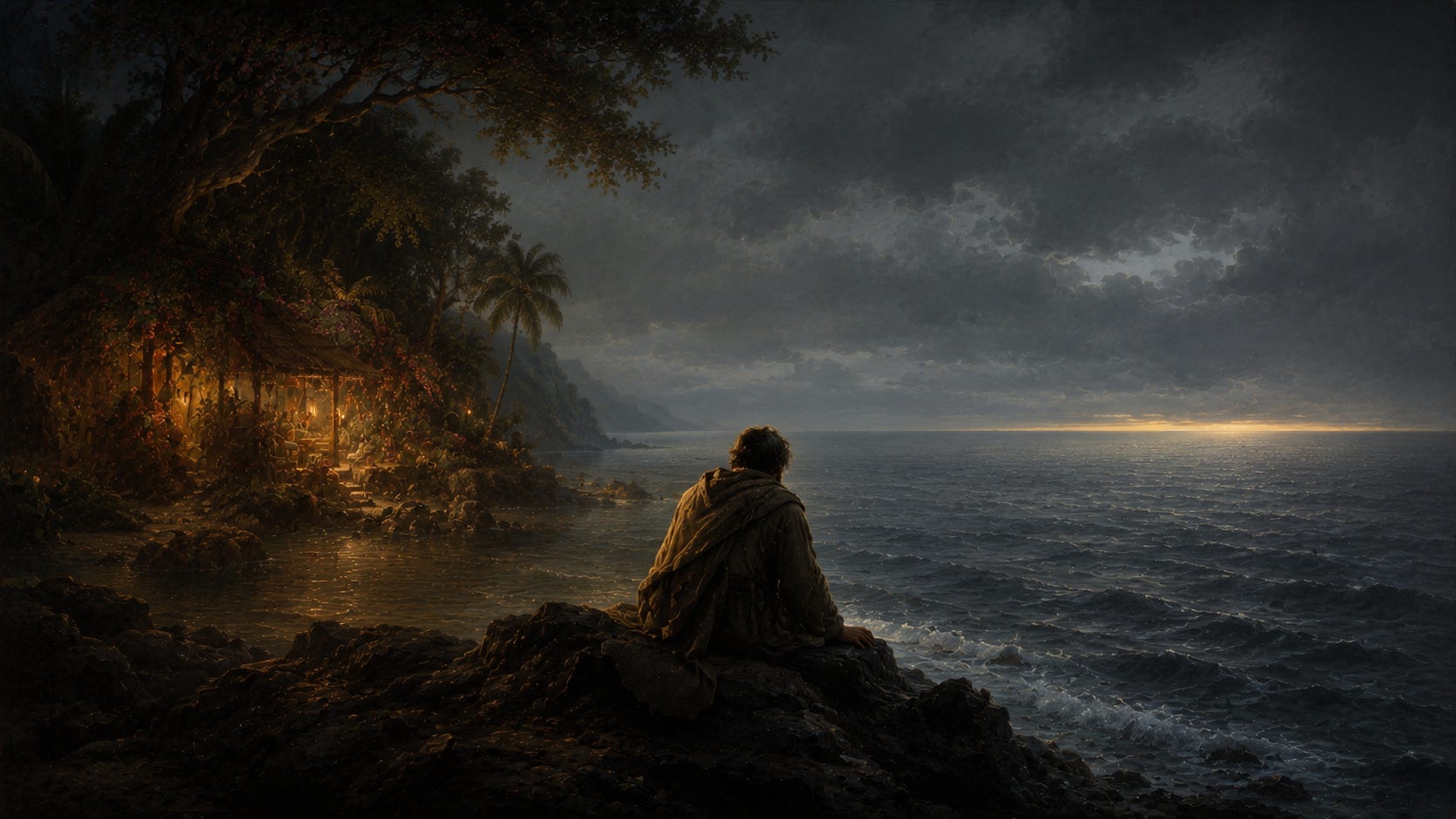
But every morning, Odysseus walked to the edge of the island, sat on the rocks and wept. Staring out at the sea in the direction of home.
He wasn’t weeping because he was suffering, or the island was perilous. He was aware of how great his life was on Ogygia. The problem was that this island wasn’t his home and Calypso wasn’t his wife. He was comfortable and content. But there was a deep dissatisfaction. These things were great, but they also weren’t his. This wasn’t supposed to be his story. He knew this in his bones.
The gods knew it too, and they intervened. Although Calypso’s island wasn’t a prison, it had turned into one for Odysseus. Calypso didn’t understand why he would want to leave and didn’t allow him to. Hermes arrives with a message from Zeus demanding that Odysseus be allowed to leave. When Calypso tells Odysseus, he doesn’t believe her. He makes her swear an oath that she’s not deceiving him to go out to sea so she can drown him. She helps him build a raft, gives him provisions, and watches him sail away from paradise. Choosing uncertainty over immortality. A hard sea over a soft island.
Truth
We will all face the choice of Odysseus on Ogygia.
There is a kind of comfort that is both comfortable and wrong. A career that pays you well, but consistently drains your energy. The friends that you love that also help maintain your inertia. Who you are today that is in something that seems good, even though you feel deeply unsettled at the same time. You’re not settled, but you’re trying to talk yourself into it. Everyone else around you might be too.
That’s exactly what makes these types of situations hard to leave. They aren’t bad. If the situation was bad, of course you would leave. It’s not that the situation is bad. It’s just not supposed to be yours.
Odysseus wept every day and still didn’t leave. He knew he didn’t belong on the island, but he still didn’t try to leave. Knowing the truth about your situation doesn’t give you the will to act on it. It just makes staying more painful. It can also make you feel guilty about feeling pain in the middle of something that’s supposed to be good.
What finally moved Odysseus wasn’t his own courage. It was an outside intervention. Our clarity comes from an external conviction. We know something to be true in ourselves, but then a conversation happens that shifts everything. We get fired, experience a loss or a moment that cuts through our comfort. In this story, Odysseus didn’t need to change himself, he needed to change his environment. Home was not where the heart is. Home was a real place, and he was not there. The gods reminded him that he didn’t belong there. His intuition was correct. He needed to leave a good situation for the right situation.
Hebrews 12 describes it plainly: let us throw off everything that hinders, and the sin that so easily entangles (12:1). The writer doesn’t say throw off the bad things. It says throw off the things that hinder, which sometimes includes things that look and feel good.
The prison of comfort is often the hardest to escape. Because when you walk out, it seems like you’re leaving paradise.
Practice
Trying to change yourself without changing your environment will make change almost impossible.
We get a choice when it comes to this prison. Do we change our inner reality to match our outer reality? Or do we change our outer reality to match our inner reality?
Yes, you’re comfortable. Things are good. But are you settled? Do you really believe this is the right situation for you to be in? Are these the right friends? Is this the right environment for your growth and the realization of your highest potential?
It’s not about just leaving the thing and going into the unknown. Odysseus knew where he wanted to go, and he built a raft.
If you don’t know where you need to go, that’s the first thing. How do you know where you need to go? What environment resonates with you, makes you feel alive, or is filled with people who are producing great fruit?
If you know where you need to go, there’s still a step to take. Odysseus knew where he needed to go, but he sat on the rocks for seven years before he started building a raft.
If you know where you need to go, it’s time to start building the raft. What does that look like? You don’t have to completely leave the old thing to start the new thing. But, you do need to start the new thing if you’re ever going to leave the old thing.
Where do you want to go? How will you get there?